
Lynching by words

Think twice before you speak, because your words and influence will plant the seed of either success or failure in the mind of another. Napolean Hill

Words are powerful. We speak them everyday when we need to and when we do not need to. Sometimes the words come from within your heart. Sometimes the words come from your mind. Sometimes you do not even know where the heck they even came from. Yet you end up speaking them nevertheless. Words, whether intentional or non intentional can carry an energy which causes disruptions  to the equilibrium of relationships, perceptions and beliefs.

Sticks and stones break only bones, they heal so fast. But words destroy and kill the soul till nothing is left at last. Rabbi Joseph Telushkin

Everyone who is reading this post including yours truly can remember at least one occasion where you said certain words and would like to go back in time to repair the repercussions from those words that were uttered. Words are powerful because they can either inspire or bore. If you are the person speaking or being spoken to, it must be remembered that being at the receiving end of a volley of words is not exactly a good feeling. As the lynching by words continues, you either fight or flight. Like battering rams being used to open the walls of fortifications in war, words leave your soul wounded and bruised.

Memories are powerful just as nostalgia is sweet. Yet words spoken last forever with the venom from its pointed arrows still remains and never leaves you. Words once spoken cannot be taken back yet what has to be said, would need to be said because the soul is ever restless when denied the opportunity to express itself. As Rabbi Joseph mentions, when the soul expresses itself, little does it know the aftermath of what it has wrought on itself or others.

How do you heal yourself from lynching by words?

  1. It is easy to say let it go and let it be, but time is the number one healer for wounds caused by words.
  2. I believe in being proactive and intentionally avoiding circumstances that may make you say something that you may regret later.
  3. Always vent yourself either alone or with your spouse or anyone who you can trust before any confrontation. It is always good to lose some steam so that in the end, the effect might be minimal.
  4. As a friend remarked recently, invest in the right relationships and terminate any that is of no help to you.
  5. As the five fingers of your own hand is different, you do not have to be compatible with everyone and it is imperative to understand the following:
    • 25% of people you meet: will never like you;
    • 25% of people you meet: won’t like you, but could be persuaded to;
    • 25% of people you meet: will like you but could be persuaded not to;
    • 25% of people you meet: will like you and will always be there for you.” Joel Osteen

This is an easy stat. One needs to focus and invest on only that 25% to have a happy and meaningful life. That limits the words that needed to be spoken and the energy that needs to be expended in maintaining relationships. Your chances at being lynched by words have gone down significantly. I can vouch for the above tips to ensure that good memories from good words may dominate your quest to go up in life.

Photo Credit: skb_inspirations via Compfight cc

Your Resume is Your Flyer

Writing a resume is one of the most important challenges facing professionals and aspiring job seekers today as they seek a job. From my short experience, I have found that there is not one perfect way of writing a resume. I have seen many formats and have remained mind boggled as to which one I should be using while applying for a position. Eventually, I decided to take the best aspects of each formats and condense them into one suitable one. Thus over the years my resume was modified continuously and issued whenever I am requested.

Every Wednesday, a bunch of flyers are delivered at my house with showing the latest deals from the shops in my vicinity. I find flyers amazing for the spot advertising that they do for the merchant. They basically show ‘just the relevant’ information regarding the products on sale each week. They are flashy, brief and convey the message in the most apt manner. More or less they guide the consumer into the intent desired from them by the merchant. Because anyone who follows these flyers into a shop, will in most probability end up purchasing more than they ever intended to, in the first place.

I would like to consider our professional resumes as flyers advertising ourselves to any organization. Whenever a position is posted, the successful applicants who are invited to the interview are the ones with a resume that is the best fit for the posted position. Many HR screening programs screen the resumes for keywords from the posted position before shortlisting them. Most of the time, interviews are conducted based on the details mentioned in the resume since it shows what a prospective candidate brings to the table.

Consider for a moment that the company is the consumer and you are the merchant with a flyer. Before a consumer purchases a product, there is an element of desire ‘to want that’ product. Then there is an element of economy, where you want the product so that ‘it fits within your budget’. Then there is an element of purpose-where you visualize what you need to be doing with that product. I think this is similar to how each company hires a person. You need to present yourselves in a manner so that the company sees you as one of their own. You need to be reasonable and humble with what you expect of the company. You need to provide that element of purpose so that the company has no other choice but to hire you inevitably.

A similar relationship can be found in flyers. Your resume is like a flyer. It has to be written in a manner so that companies desire to hire you. From my experience, most of the time true impressions about oneself is generated by your resume. It is important to have an updated resume at all times. Every time before applying, one needs to ensure that all the keywords from the job advertisement are clearly captured both in the resume and in the cover letter. Always imagine of yourselves as the merchant selling the merchandise. You should ensure that you advertise yourself in a professional manner using a meaningful and purpose driven resume.

As a continuation to my earlier post, where I mentioned about how I found my first job, I have tried to follow the above tips consistently. The power of tailoring your resume as a flyer so that companies desire to at least invite you for an interview cannot be denied.

8720890589_9dec0ee476

Featured Photo Credit: igniteresumes via Compfight cc

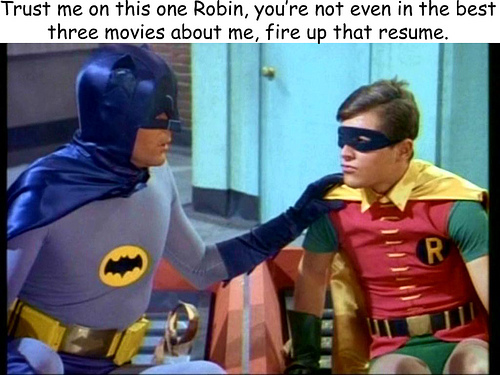
Batman Photo Credit: jvandusen2013 via Compfight cc

The views expressed are those of the author only.

Do what you said you will do

One of the most important traits that one needs to develop in his path to a successful and meaningful life would be to do those things, he once said that he will do. The other day I was reading the bible and the Parable of Two sons (Matthew 21:28-32) came into focus. The second son, who assured his father that he will work in the field and later didn’t go resembles a classic trait I have seen in many people including yours truly, both in personal and professional lives. Politicians are normally famed for actions that are not measuring up to their promises. Seldom do we realize that sometimes we are in fact worser than politicians in promising too much and not delivering at all.

In our fast paced lives, we would always love to be seen as being the right one. In our family life, our meetings with friends, our interactions with our community and in our place of work, we would like to be seen as politically correct and also would love to appear the righteous and flawless one. It is so easier to pin all the negativity and blemish on others, because we are perfect and all that is good in the world is within us. Due to this urge to be the right one, we end up promising a lot, because with all the superior qualities bestowed upon us, we are always right and dependable. Then the greatest tragedy of life happens, when we cannot deliver what we once promised. I have seen that sometimes people do put in arduous amounts of effort to ensure that at least something is done and showcased. It is often at a heavy cost of poor shoddy work and sometimes even loss of reputation.

What then is the secret to prevent such a situation? I would never say that we should never aim to be the right one, but if we ever claim to be so, one needs to live up to it. Have you ever faced a situation where you couldn’t match your words with action? I have been guilty of this offence a million times from what I could remember. I remember that one of the managers under whom I worked with at one time, called me a ‘dangerous optimist’. I have seen myself tire our because of this nature since I promise a lot and sometimes end up delivering a shoddy product. Most of the time it is the urge to be active and productive, but what is the point in doing so if you cannot produce a quality product?

What then is the solution? Is it the 80/20 rule where you would do 20% of the tasks to at least an 80% satisfaction. Or is it being intentional on to what you can actually do. I think it should be part of understanding what type of person you would like to be in life. Do you want to be like the younger son who is a people pleaser but is hollow inside because he never intends to do anything at all in the first place. The challenge is to be honest and forthright about what you can do and the promises you make. Being intentional about yourself and understanding your limitations and thus being open about it may not help you to get friends in life or sometimes even lose the ones you have. It may make you an outlier within both your family and community. But who cares, you are what you are and if you can deliver what you said you will, you are a winner.

“You are what you do, not what you say you’ll do.” C.G Jung

Featured Photo Credit: Daily Dividend via Compfight cc

Contentment

How long does it take to get what I so wanted,
How long more to make myself happy,
How long must I wait to be contended with what I have,
How long before I get inner peace?

Nothing in my life is certain for sure,
Wait and wait I have to for a long time,
To achieve what I desperately needed.
I cannot complain that I am not happy,
But the wait makes me lose hope sometimes.

Even when I wait, I watch with dismay,
As people achieve that I so earnestly need,
Less the effort than I have to put in,
Quicker they get it than me,
Wait and I wait for these same things,
I get them only when the creator decides for sure.

Why do you make me wait my Creator?
How long before you feel that I am worth it?
What is the lesson that you want to teach me?
As my time goes on in this earth,
I see people consume and consume,
I am a poor man who seldom gets his way,
Lament like a child for time and effort it takes in my life.

I see the rich happy in their consumption and sad in their emptiness,
They fill themselves with goods all around them,
But their hearts are empty and minds desperate,
Yet they consume and consume.

Debts pile up, credits are lost,
They squander off their wealth in aimless disharmony-
Destroying their lives and the nature around them.
Dumbfounded at this realization,
I look around with a sense of understanding
That my life is not defined by what I want,
Because I am provided by the Creator with what I need.

My aim in life is not to live to make myself happy,
Rather I have to find the contentment within myself,
And help others in their quest for the same.
In the long haul there will always be happiness,
There will always be contentment.
Yet there is the realization that,
You do not need many of the things
That you wasted your life for at one time.

A grateful heart is a beginning of greatness. It is an expression of humility. It is a foundation for the development of such virtues as prayer, faith, courage, contentment, happiness, love, and well-being. James E. Faust

Image courtesy: https://www.flickr.com/photos/7659680@N07/1047095765/

Have a Plan

‘It is always important to have a plan..’ I have been told this a million times by a lot of of people. Sometimes when the outcome sours, I also find telling myself the same. Being an impromptu person, I cherish that last minute work. Doing it at the last minute gives me the ability to have undivided attention to the outcome. This was a trait that I developed from my school going years. Studying for the exams on the eve before, practising your lines an hour before the extempore competition, the last look at the notes just before entering the examination hall- situations that had instilled in me a feeling that, there is always a last moment to get it done. My college mate used to say, “Better late than never” and I truly believed it. Sometimes things are better done in the last moment and sometimes it is better to be late in doing something.
 
There is never a perfect season to get something done. The perfect occasion, the perfect alliance, the perfect job never happens most of the time. Yet without you doing anything, things that are destined to happen, will happen. If you hope for it and believe in it and with the right attitude, any occasion, alliance or job will be the perfect one for you.  I’ve always believed in these words and hence I was never used to a ‘plan before you do something culture’. Coming to Canada, this belief was turned upside down.
 
‘It is always important to have a plan..’ remarked all my supervisors till date since I stepped foot into this country. I have seen how time and energy and spent in just planning outcomes so as to minimize surprises. There are MS Primavera or MS Excel spreadsheets, Mindjet Mindmaps etc., that show the schedule and how non deference to the schedule impacts costs. Every project I have been in, there is a constant battle between the two sides of the balance- schedule and cost. To balance them effectively in a rapidly changing society is what makes an ideal Project management professional. To a last minute person like me, who has been taught his entire life and even practised the same-the virtues of last minute work, these realization was nothing short of a revelation.
 
Slowly and steadily I got into the bandwagon and I started seeing results right away. I started using tools like Google Keep, Evernote, Sunrise, Wunderlist and designed my life around these tools. Stickies on the wall, scheduled tasks etc started showing me many things that I have been missing out. I started showing improvements both in my professional and personal life. I would like to say that just by merely planning didn’t simply do the trick- the one area that I was able to influence by going ahead with a plan was to reduce the delta between expected and realized outcomes. Expected outcome is what happens before one commits to something. Realized outcome is what actually happens. I have seen that the difference (delta) reduce significantly with a solid plan. In a project, this difference is affected by many factors some controlled and some uncontrolled. True success is in managing both set of factors.
 
How to make a solid plan? I would like to start at the outcome and work backwards. I always try to use a mindmap, a tool that helps me throw my ideas out there. I take this mind map and dump its various attributes into one of my reminder tools such as Evernote or Google Keep to ensure that they are completed in due course. It may not be most perfect way to get something done, but it helps to reduce the delta. My main objective is always to reduce the delta though sometimes it just slips from your hand and you can do nothing. The best part here is that there is at least a semblance of some control. I love to be in control and whatever be the resultant outcome, I can always be assured that I did my best and I did have a plan.
 
“To accomplish great things, we must not only act, but also dream; not only plan, but also believe.” Anatole France
 
Photo Credit: PymesCanarias via Compfight cc

We are all refugees

The refugee crisis in Europe is a stark reminder of human suffering. The picture of the young boy, Aylan Kurdi was startling not because he was not the first one to have died like that- infact over 2000 people have died trying to cross the Mediterranean fleeing the oppression of ISIS from Syria. However unfortunate it is, the world community would need to clearly define as to how it would take care of refugee problem, anytime it occurs in the world.

Refugees are a byproduct of calamity-man-made or natural. In today’s 21st century, nothing about of our lives can be said for certain. Whether it is being slaughtered by ISIS or forest fires burning your house and all your possessions down, calamities can be considered as thieves-they strike you at the worst time in your life and they carry away with them something that you treasure the most. It is a pity the Syrian people had a rough time for a long period in their history-first under a brutal dictatorship and now refugees in an unknown continent.

Everyone will have a perspective on this story-that the Europeans should shed all their prejudices and accept these refugees with loving arms. Except Germany, most of the countries are in a state of decline with the European Union acting as a glue to keep many of these quasi-failed states together. People calling for other developed countries like U.S and Canada to accept more refugees are missing the point that-is it the solution? These countries are already accepting more refugees per year that they can actually do.

What then is the solution? Since religion is the root cause to all these misery, no one would want to talk anything about it as there wouldn’t be no rational argument to be made about anything regarding it. I think the United Nations should urgently meet and discuss a lasting solution with all its member countries. In this 21st century with Internet and social media breaking apart all the barriers that separate us, a unified framework should be developed where people should be allowed to travel anywhere in this world provided they have the basic identification documents. Every human must have the right to apply for and work anywhere in this world. Every human should be allowed to co-exist with each and every one of his kind-peacefully. Nationalism must be defined in such a way where the citizens of each country must learn to accept other humans to their country and work together so that all nations of this world co-exist peacefully.

If you see the countless videos and pictures of these refugees, we can see the despair of having lost everything they had and running with the only thing they have left-their lives. Our sense of having any sense of worth in this world will only be when we can accept any other human being regardless of the colour, caste or creed. It is easier said than done as I am also sometimes susceptible to my own prejudices. But how can we allow a blind eye to this suffering and expect someone to take care of us when a similar calamity of this magnitude strikes us?

In one way we are all or will all be refugees at one time in our lives.

Image courtesy: http://www.reuters.com/article/2015/09/02/us-europe-migrants-turkey-idUSKCN0R20IJ20150902

Take a break

My last post in the blog was on June 7,2015. Till then I was at the rate of writing one post at least each week. After my last post, I felt thoroughly drained and couldn’t come with any new ideas. I decided to stop writing for a while and concentrate on other things. Enjoyed my summer by attending countless bbq parties, camping, adventure sports and travelled quite a bit. Being in Canada, even though the government and companies work hard at promoting a solid work-life balance, most of the time it is never the case. Either in home or at work, I have seen from experience how Murphy’s laws are consistently fulfilled causing you to be in tenterhooks till the problem gets fixed. Sometimes, one gets the feeling that he/she cannot take a break as work keeps piling up. One then hopes and longs for that long vacation to take a break and seemingly fails to do so because vacations usually ends up with long travel times, delays and other unexpected events that throw you off the balance. In short, you are simply working all the time. And it is not good. Because working all the time doesn’t necessary translate to high productivity.
 
Our brains are not like the modern CPUs always plugged in and solving problems for us. Being an integral part of our body, our brains do need downtime to process the plethora of information that comes its way. Let’s take the example of the information that comes our way daily- At work we are faced with documentation after documentation of seemingly never ending information. To unwind, we turn our focus to social media where we are again inundated again with never ending information. Where does the brain gets time to process these information? How does it ever filter the information to see what needs to be retained and what doesn’t need to be retained? Our brains need substantial downtime to generate ideas, connect the dots between the information received on a day to day basis and provide us intuitions that takes us to promising new destinations. “Idleness is not just a vacation, an indulgence or a vice; it is as indispensable to the brain as vitamin D is to the body, and deprived of it we suffer a mental affliction as disfiguring as rickets,” essayist Tim Kreider wrote in The New York Times.
 
Ferris Jaber writes in the Scientific American that when we are relaxing or daydreaming the brain is not seen to slow down or stop working and instead a ‘dazzling array’ of molecular, genetic and physiological processes occur primarily or even exclusively when we sleep at night. Quoting the work of Mary Helen Immordino-Yang and her collaborators at the University of South Carolina who found that when we are resting the brain is anything but idle and that far from being purposeless or unproductive, downtimes is sessional to the mental processes that affirm our identities and develop our understanding of the human behaviour. The detailed articles extols the virtues of rest management and how to ensure optimum productivity levels are attained.
 
“Every person needs to take one day away.  A day in which one consciously separates the past from the future.  Jobs, family, employers, and friends can exist one day without any one of us, and if our egos permit us to confess, they could exist eternally in our absence.  Each person deserves a day away in which no problems are confronted, no solutions searched for.  Each of us needs to withdraw from the cares which will not withdraw from us.” Maya AngelouWouldn’t Take Nothing for My Journey Now
 
I was never a proponent of sleeping or taking rest and I used to push myself everyday as I felt one shouldn’t waste time resting and needs to get things done. Recently I forced to take rest following a freak knee accident. As I gave myself adequate rest, I could see that the rate of healing was exponentially proportional to the time I rested. My own perspective on rest has changed dramatically ever since. Sometimes one just needs to unplug and allow the body and eventually the brain to catch up.
 
Recommended reading:
  1. http://tinybuddha.com/blog/40-ways-to-give-yourself-a-break/
  2. http://opinionator.blogs.nytimes.com/2012/06/30/the-busy-trap/
  3. http://www-bcf.usc.edu/~immordin/papers/Immordino-YangetalRESTISNOTIDLENESSPPS2012.pdf
  4. http://www.scientificamerican.com/article/mental-downtime/
  5. http://www.treehugger.com/health/why-your-brain-needs-breaks-work.html
Photo Credit: Tim Allendörfer via Compfight cc

The Talent of Time

‘Once upon a time’ did start the tale,

Of the rich man that gave each his servants talents.

Some used it well over time and was rewarded in talents,

One saved it well over time and lost all he ever had.

In no time did the tale get over.


Time and tide never waited it did ever,

Stories were told and songs were sung.

The sun rose and the day rung,

The sun set and the night was flung,

On people who simply rose and fell.

Seasons went by though cyclically,

Yet time kept on marching forward ceaselessly.

Earnestly and diligently did he work each day,

To do those things he wanted to do someday,

Dreams and hopes he had many,

He was eager and he had the way,

It was easy for him to start them quickly,

He did not know if he could complete them quite easily,

For time was his friend and his enemy.

He did not know whether to trust it come what may.

When he needed time, he do not have any,

When he did not need time, he did have many.

With time everything will be alright,

Said the seer to the impatient man in his youth,

He wasnt ready to accept the commandment,

Hot blooded and never without remorse,

He did not heed the advice and went on his way,

He did the unthinkable and realised his folly,

Wasted was he as he spent the rest of his time.


As a man can change his image in front of others,

He can never change his time that shows his image over the years.


Listen my dear friend, your time is your talent,

Use it wisely and you will be given more,

Dont be foolish not to use it judiciously ever,

You use your time well and you will be blessed many times over.


Photo by Aron Visuals on Unsplash

The Art of Questioning

“Learn from yesterday, live for today, hope for tomorrow. The important thing is not to stop questioning.” Albert Einstein

Among the many traits that I was known for from childhood, one that stood out was the unstoppable trait from my vocal cords asking ‘Sir, one question, please’. Traditionally in a school environment, the teachers asks questions to students based on an information-seeking model which relies on a predetermined subject taught by them. In my growing up years, I remember subjects such as biology, geography etc., where I simply crammed text books to get good grades in exams. The right answers in these subjects were praised and the wrong ones were corrected. Most of the time we were discouraged from articulating our thoughts. These subjects never struck an emotional chord with me and I never meandered even near them once high school was completed. However in some rare classes we had teachers who provoked us to articulate what we thought about the subject and why we thought differently.  We were encouraged to elaborate on our previous answers and ideas, and thus the process helped us to have conceptual knowledge. I still remember subjects like maths, computer science, physics and chemistry to this day because of this approach taken by those teachers that taught them. The fact that I chose my profession as a Process Engineer bears strong testament to the questioning method permitted by the second approach.

Questioning is rarely encouraged and generally frowned in organized communities including religious societies even though the religious texts do sometimes encourage questioning. Prior to Renaissance, the christian catholic church encouraged a credulous medieval spirit that accepted any picturesque tradition or marvellous tale without inquiry as to its source or credibility. However during Renaissance there was a new found questioning and critical spirit which first awoke Francesco Petrarca, also known as the father of Renaissance in Florence and then spread around the world. Renaissance had profound effects on humanism, arts, science, music and even religion. It actually propelled our civilization to the modern age that we currently live in. However even to this day, organized religion dissuades questioning and refuses to evolve causing incessant human grief and suffering.

“The key to wisdom is this – constant and frequent questioning, for by doubting we are led to question and by questioning we arrive at the truth.” Peter Abelard.

How to question? Have you ever heard about the 5 Why method? Two years ago, I was introduced to this method by one of my mentors in the company I earlier worked for.  5 Why is an iterative questioning method which helps explain the cause and effect relationship to any particular problem or situation. It is very simple. Suppose you have a problem or an issue at hand and you want to know how fix it so that it doesn’t happen to you or anyone again. You ask 5 Why questions, iteratively based on the answer to the preceding questions. For example let’s consider an imaginary conversation between Bob and his son Sam.

Bob: Why is the car not clean, Sam?

Sam: I did not get time to clean the car.

Bob: Why did you not get the time to clean the car, Sam?

Sam: I was busy in the afternoon.

Bob: Why were you busy in the afternoon?

Sam: I was busy as I had friends over.

Bob: Why did you have friends over?

Sam: I had friends over as we had a game session.

Bob: Why did you have a game session with your friends and did not let me know?

Sam: ……I am sorry.

Without understanding the root cause, simply trying to resolve the effect may/ may not prevent the reoccurrence of the event. Sam in this story was clearly hiding the fact that he had friends over and he did not take cleaning the car as a priority. Note how within a span of 5 question, Bob was able to understand why the car was not cleaned by Sam. Thus by questioning, one is able to understand the root cause of any problem and then find the fix or solution. 5 Whys were first used by Taiichi Ohno, the architect of the Toyota Production System in the 1950s who describes the method as “the basis of Toyota’s scientific approach, i.e.,  by repeating ‘why’ five times, the nature of the problem as well as its solution becomes clear.” It is a very simple process and can be used for a wide range of applications from problem solving to even questioning beliefs, assertions and even daily issues.

Summarizing the ability to question is a necessary skill one needs to have in this ever changing world. It is important to ask the right questions to obtain the right answers. I agree that sometimes it is hard to make sense of this world that we currently live in or the people that we meet each day. However by questioning and never conforming, one should be able to see his/ her world in a new light and carve a new path for themselves.

Image courtesy: https://www.flickr.com/photos/marcobellucci/3534516458

All images follow Creative Commons license. Slightly cropped the source file.

How I found my first job and learnt from it

Like any graduate student I was at the top of my world, the day I completed my four year program in Chemical Engineering. After all the learnings and hardships from the years gone by and reaching the summit of achievement, I felt like a king and waited to take on my next big challenge-the world. I was mighty excited as I felt myself to be extremely skilled and qualified to do fantabulously well in the next big chapter of my life – a job.

Since my parents lived in Abu Dhabi, I didn’t bother to spend time looking for a job in India. Also apart from IT based jobs, there were very few jobs that came calling in my speciality-Chemical Engineering. Considering my engineering background it made sense for me to look for a job in Abu Dhabi as it is an oil rich province with several upstream and downstream processes. I thought it would be easy for me to find a job and I arrived in Abu Dhabi without much preparation just before the advent of summer.

In those days, Internet was just getting mainstream and hence most of the job postings appeared in the newspapers. I began earnestly applying for jobs that I found in the classified section of the local newspaper. Very quickly I found out that most of the plum chemical engineering jobs were in the national oil companies and they were ready to hire me on any given day provided I had ‘experience’. The word ‘experience’ is a dreadful word to any fresher looking for a job anywhere in this world. For the next six months I kept hearing this word again and again and came to the conclusion that I should have done a degree in ‘experience’ and not in Chemical Engineering.

The private sector of Abu Dhabi that worked in oil and gas were service providers with a majority of employees as hardcore salesmen. I was able to land a few interviews in many of these sales companies but I had to turn them down as had I taken the offer, I would have to bid adieu to all the technical knowledge that I painstakingly acquired in the past four years.

As months passed by, I began to grow desperate. I wasn’t able to land any good job. adding insult to injury it was the year when the oil price touched record highs and there were expansion or maintenance projects in the entire oil and gas sector of the Middle East. I realized that my resume which was basically an achievement based resume did not make any sense since I did not have the requisite experience for the position that I was applying. I then decided to redraft my entire resume to one where my skills gained prominence.

Next I decided to knock on doorsteps of as many oil services companies with print copies of my modified resume. With a keen attention to my presentation, I tirelessly walked towards many companies and did the honours. Incidentally it was in one of those companies that I landed my first job months later due to other reasons as will be explained later in this post. The next strategy was to ‘fax bomb’ all the companies with my resumes and some of the prestigious ones with both my resume and cover letter attached. Both the endeavours failed miserably. I did feel desperate, but I was not willing to give up.

Networking was the next thing I employed. In my community church, among our family friends, I made it a point to discuss about employment options in their companies. Many of them helped me with timely advice and forwarded my resume within their companies and to their contacts working in other companies. Most of the efforts were unsuccessful, but I kept hope and did my follow-ups.

Eight months later I received the call that would finally launch my career. It was for an oilfield services company that was looking for a Chemical Engineer to work both in onshore and offshore projects for their oil recovery equipments. One of the senior managers in that company on his visit to a subsidiary of my dad’s company remarked during a casual talk  that his company was looking for a chemical engineer. One of my dad’s friend with whom I conversed about my job search, quickly reminisced  and provided him with my resume. He took the resume to his company and I secured my interview.

During my first interview I realized how my education was so inadequate to the job that I was embarking upon and the only thing that helped me ace that interview was the skills that I cultivated during my education and job search period. I resolved to work hard even for a very low paycheque because I needed experience. As I made my way out following a successful interview, I noticed a person standing in the reception and dropping his resume to receptionist asking for a job. As he turned around, the receptionist threw it into the bin.

Some of the main lessons that I learnt from my experience is as follows:

  1. Finding a job is like trying to catch a butterfly. You need to be tenacious, focussed and remember never to give up.
  2. Education is good as long as you can show it as a skill and not as an accreditation. More the skills, the merrier your job search would be.
  3. Timing is very important. One of the main reasons why I had to wait 8 months to get a break was that I started searching for a job just when half of the city was planning to go on summer holidays!!
  4. Networking is very important in landing a job. If you can network far and wide and sell yourself extensively, you will be able to find your opening. However never forget any of your networking contacts or colleagues. They are your life-long friends.
  5. Always keep applying to jobs near and far. Be tenacious, focussed and aggressive. Remember all you need is that foot through the door.
  6. Presentation of your resume and even yourself matters. In today’s world, you do need a vibrant social media profile to complement yourselves. Remember that you are selling a product which coincidentally is you, your life and your dreams.

Image courtesy: https://www.flickr.com/photos/jips/3579763940/

All images follow Creative Commons license. No changes were made with source file.