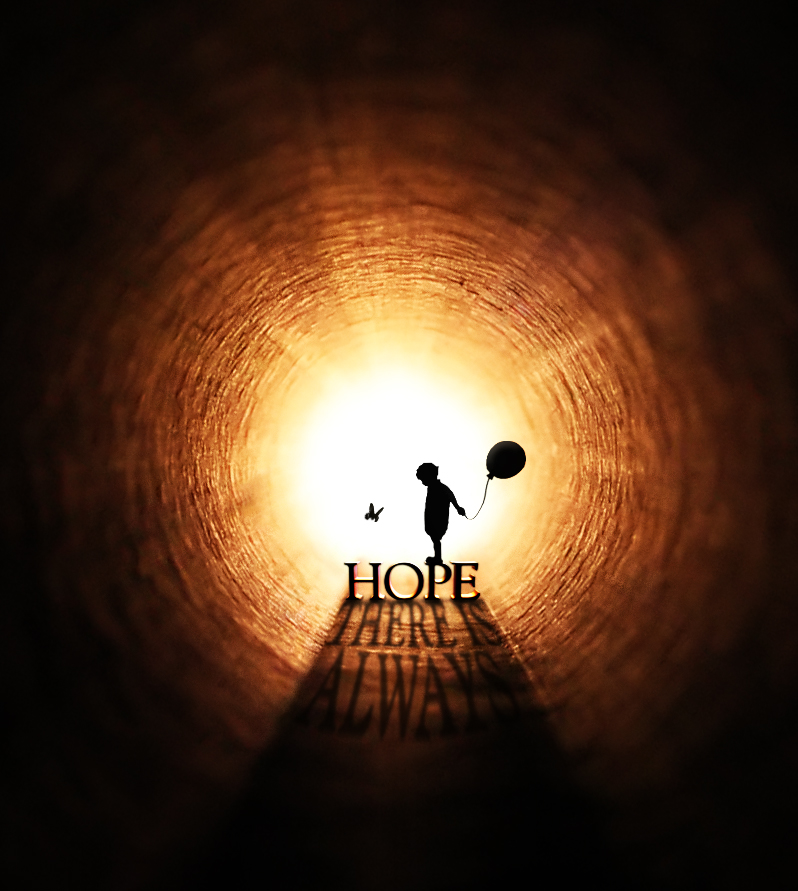
Of Hope & Uncertainties

There is an old saying, “Never take life seriously, it is going to kill you anyways.” I have always thought about this statement. On one hand, we have our lives as a gift from above and we are entrusted in ensuring that we live it up to our fullest potential. If an average man lives (say for instance) up to 70 years old, he has a finite amount of time left to leave his mark (if he intends to) in this world before his death. Death is a certainty, living life of significance and up to its maximum potential is uncertain.

We live our life believing in hope. Hope for a better tomorrow, hope for a better job, hope for a better and prosperous times etc. We have faith in that hope that ‘in the end, everything turns out for the good’. But what would happen when a person is convinced that there is no hope left? There is no hope that the status quo would change. There is no hope that the economy will get better. There is no hope that your dreams would not come to pass. When hope fades, purpose dies and uncertainty kicks in.

Let’s take an example of a sea faring sailor. By the time he sets for sail, he wishes to sail to his destination. It is not even certain that he would reach his destination. There is a possibility that he could die in the raging seas before he even reaches his destination. Yet the possibilities don’t deter him, but the uncertainties spur him on. Most of the time life is like that.

I have always felt uncertainty as stagnant water. It neither goes up (evaporates) nor does down (drain away). And to add insult to injury, it breeds mosquitoes. Mosquito bites are never blissful. I hate mosquitoes and also uncertainties. But just like the sailor, I move on.

If uncertainty was a chapter, hope is a book. Hope never ends. Our loss of hope welcomes uncertainties. However one should realise that you can only finish a book by finishing a chapter. And a book will end, only when everything turns out for the better in the end.

Image courtesy: http://rsdkids.com/wp-content/uploads/2012/07/There_Is_Always_Hope_by_Krzyho.jpg

Reset. Spring. Start

Since Lent began more than a month ago, I haven’t been writing anything for ‘The Raya’. I decided to take a much needed break from writing and get myself refocussed and reoriented. It was a testing and trying period for me and while writing this post 40 days later, I feel a sense of redemption. The holy week for Christians have begun which will culminate on Easter Sunday as our Lord whom we crucified, rises up in all his crowning glory.

Spring is a time of redemption. Another winter is pushed away and the bright rays of sun signal a new awakening. Living in a cold country such as Canada which is known for its magnificent winters, one gets to understand the full force of darkness and cold.

Beginning from mid-November till about February, it is mostly dark and cold in these places. Its a time of connecting with people, partying and at the same time working hard like there is no tomorrow. Spring is different altogether. Its a time for a fresh new start.

Since I launched this blog more than a year ago, this was the longest I went without writing a post on this promising blog. It was also a period when I successfully partook in my first ever Lent. I abstained from everything non vegetarian and stuck on a strict vegetarian diet. It was tough but entirely possible.

Spring is here. Next week, Jesus would have risen. Its time for a fresh new start.

Image courtesy: http://farm2.staticflickr.com/1034/1418479869_6b2d1d4aeb_o.jpg


Managing Obnoxious People

When you ask any manager worth his penny, what would the greatest challenge in his profession be, his quick response would be, managing people. People are the currency of life. They are everywhere. From kith and kin to friends and enemies, from colleagues to acquaintances, people adore your life. They give you happiness, joy and open your mind to possibilities. They give you reasons to think, reasons to love them and reasons to hate them. More or less, they are all different. Different varieties, different behavioural characteristics and they are different just like the different fingers that adore your hand. As they say, variety is the spice of life; different types of people that one meets in life provokes, instigates and ultimately leads him to his destiny.

Of all the people that one meets in life, mean or obnoxious people are the real game changers. They appear most of the time as being created to be loathing, selfish and greedy. They are designed to provoke you, instigate you and watch you rot and burn with glee and laughter. Everything that you do for them or for that matter anywhere doesn’t mean anything to them. They demand attention from you, they shout and yell at you and they wouldn’t even bother to care about you. For them, most of the time they are the centre of their universe and everyone are mere constellations or planets that orbit around them.

Many of my readers here would agree with each and every word that is being said here. I have seen many mean people in my life and many times have acted being the mean one. Well that is life. One day, it makes you the hero and the next day you become the anti-thesis of what you were or preached once. So the question here is not to who is mean but how do you manage one? I have listed some few suggestions based on my experiences dealing with such people.

  • Most of the time, don’t engage them. Don’t be their audience unless they have some ingenious plan to treat world hunger or cure cancer.
  • Understand that just like you, they are also human. So this brings with it the usual package of stupidity, mediocrity and random behaviours.
  • Learn to love them for what they are, and not what they have become. I always believe that God places people, good or bad in your life for a reason. Those whom he deems unnecessary exits your life quickly and those that are relevant, good or bad, linger around.
  • Don’t ignore the mean and obnoxious people in your life because sometimes in their words and intent, one can find important cues that opens a mirror into who you really are. Such a self introspection is immensely valuable in unleashing your true potential.

I would like to conclude by mentioning what I mentioned in the beginning. People are currency. How you use it is important.

Anarchism and Leadership

Merriam-Webster defines anarchy as “a situation of confusion and wild behavior in which the people in a country, group, organization, etc., are not controlled by rules or laws”

The past week has been very tumultuous for the people living in the capital state of Delhi in India. A democratically elected government was on the streets for a myriad of reasons regarding administration, which they couldn’t perform satisfactorily. According to the newly formed Aam Aadmi Party of India, the democratic institutions of the state of Delhi, weren’t answerable to the elected representatives due to archaic laws and hence they couldn’t administer as per their mandate. The government took to the streets in protest and when asked by the media, they retorted to calling themselves as ‘anarchists’. Since then debates flared across the social and mainstream media of India about anarchism. It is a powerful contrast to democracy and its principles of stability, hope and growth.

What exactly is anarchism and who exactly is an anarchist? From time immemorial, among the ranks of populace, self-guided, purposeful and motivated people have risen to challenge the societal status quo. Their presence points to a social outlier and their message challenges conventions and order of the day. Jesus was an anarchist. His activities and his message during his three and a half year old public ministry, disrupted the world of his day with an effect that was gargantuan in nature. Throughout history, one can see of many such anarchists spread across many societies. Prophet Mohammed was an anarchist as he challenged medieval Arabia and united it into one of the powerful and richest civilizations that the world has ever seen. Karl Marx through his writings was an anarchist as it defined the Soviet and Chinese societies of 20th century and list goes on and on.

Is anarchism then leadership ? I believe so. True leaders are never worried about upsetting the applecart or status quo. What makes them successful is that they challenge the system from within and disrupt its order and status quo accordingly.  It is so true in the case of Jesus, when he said that he dint come to the world to break the Law but to fulfil it. Prophet Mohammed brilliantly converted a trader tribe struck in medieval customs and traditions not by breaking or destroying the latter but building his idea of Islam on them. This is exactly the reason why the Kaaba remains entrenched as the holiest shrines of Muslims to this day and Abraham (Ibrahim) is still a spiritual father to Muslims worldwide. Karl Marx hated Christianity or for that matter any religion. He called it ‘an opium’. Yet the Communist principles of today are so reminiscent of some of the teachings of Jesus.  Closer analysis would lead one to conclude that communism is indeed a political fulfilment of apostolic order of Christian times.

Anarchists are true leaders. They show the society that the status quo isn’t working for them. They clearly point out that the system needs an overhaul and change is inevitable. But they don’t run away from their message and they remain laser focussed on their objectives. India of late has seen the arrival of two anarchists who are determined to alter the status quo. One is opposition party’s Prime Ministerial candidate Narendra Modi who being an outsider to the Lutyens brand of Delhi’s political club is determined to drive home his message of good governance and inclusive development. The other is the former administrative official Arvind Kejriwal who is driving a strong anti corruption plank with an eye on a radical left model of governance. Both are anarchists in my opinion and it will be interesting to watch in the coming months as to whose message will be embraced by the Indian electorate.

Image Courtesy: http://crushedtees.com/ebay/1600×1600/anarchy_large.jpg

The Art of Execution

How many times have we been in a situation where we are forced to redo something that we felt that we have completed the first time around? How many times have we felt despair and dejected in revisiting the same pages of the project we thought was completed the first time around and endure the pain of rewriting and reediting it once again? We’ve all had our good times and bad times. Sometimes we get it right the first time around. Sometimes we toil and toil, redoing and reediting it again and again till we get it right. It is always a pleasant feeling to be in former category rather than in the latter category. However I feel that there are options in front of us to ensure that we can make the situation to the best of our advantage.

One of the ways in which one can avoid the repeatability disease is to ‘Plan First’. It is highly essential to take your own time and understand the project at hand, research it well, understand and define boundaries around it. Once this is done, a picture of the end product begins to emerge.. Having that picture in mind, develop and define your product, iterating along the way. Once the product is completed, a thorough review should be done and the product should be advertised in a way that shows its pros vehemently. If the marketing of the product is done right, its flaws would either be too insignificant to warrant a re-work and the author will be commended in getting the job done well. One example of this approach is done by Apple whenever they release a product. Apple takes a long time to patiently and painstakingly design and define or improve on a product category. This is to ensure that flaws are kept to a minimum and the consumers are wowed in the beginning itself. Having a completed product with no glaring defects ensures reputation and respect which in turn ensures that a premium capital is obtained from the product. Apple has been very successful in this criteria whenever they have designed hardware like the iPod, iPhone or the iPad.

The second option to take is to accept the fact that ‘iterations with constant feedback’ is necessary to ensure a class product is developed. In this approach, each product/project is given a long term view and is developed with constant/continuous changes with constant or regular feedback. This ensures that time between development cycles is minimum and constant refining of the product happens. Engaging the audience or the referee consistently would ensure that the product is refined just like a potter improves his clay masterpiece in the potter’s wheel. Constant engagement and refinement are arduous and expensive, however this within an environment of loyal and patient audience would prove highly successful. Microsoft is known be in this category especially while developing software. This constant and consistent refinement of its product category supported by a loyal client base has ensured that the software (primarily) behemoth stay relevant and highly profitable even when it had missed the mobile revolution party.

Both models work well and have proven to endure. Which model would you like to employ in your organization or project? Please feel free to drop in your comments.

Image courtesy: http://actioncoachchuckkocher.com/files/2011/12/OnTarget.jpg

Bible and Prosperity

I have been listening to Joel Osteen since 2004. It was during a channel surfing exercise that I accidentally chanced upon this tele-evangelist with Richard Gere-esque looks. He had a positive and practical aspect to his messages which was a refreshing change from many a sermon that I used to hear till then. Till date, I have listened to Joel Osteen using the Podcast app on my iPad without delay. He inherited his church from his father and within a very short period of time, the Lakewood Church became one of the largest independent churches in United States of America while all his books have become best sellers. Even though I am a strong proponent of the traditional form of church, I find no harm in listening and incorporating the positive strands from his sermons.

Couple of weeks ago, Joel’s weekly podcast was about Prosperity. He remarked that people how people alleges that he is a strong proponent of prosperity gospel. He remarked that he might or might not be a prosperity evangelist but he will never be a poverty evangelist. This made me think. Why doesn’t people like prosperity? I for one, love and aspires to be insanely prosperous. In our short sojourn in this world that we call life, all the material wealth that we accumulate wouldn’t be anyways carried off with us once we leave.

Taking this as a challenge, I decided to revisit what the Bible speaks about prosperity. Right from the book of Genesis, one can see how Adam and Eve prior to their fatal mistake, lived in a garden where everything was provided for and taken care of. Abram who lived an ordinary trader life with his family saw his wealth increase exponentially many folds once he heeded the call from God and his descendants morph into a multitude of races that literally filled the entire earth. Jacob who was shy and sly in cheating everything from his brother had the audacity to seek forgiveness and believe in the same God of his ancestor Abraham. He had to work for his fortune, but with time he became immensely rich. His own son Joseph who was close to God, ended up ensuring that Egyptian pharaohs became immensely wealthy and built amazing architectural marvels that prevail to this day. Think about David a shepherd boy neglected by his own family, became the first true king of unified Israel. His son Solomon who was not accurately chronicled by historians established one of the first truly modern empires,

What does this all mean? Compared with the message of Jesus that is sometimes reminiscent of a socialist outlook, is seeking prosperity a sin? I don’t think so. Is the Bible all about prosperity. Nope. Neither is it all about poverty. The Bible clearly says that ‘Seek ye first the kingdom of God and all these things shall be added unto you’.

Everything that the Bible teaches and shows man is that nothing is impossible. Everything is possible. Have the intention to set audacious and challenging goals and work towards it. As it is said, fortune favors the brave. Similarly unrelenting belief empowers the faithful to attempt extraordinary things. But one must have the courage to first believe it is even possible. This sets you on a march towards prosperity, where everything you dream for can be attained.

#AAPCon or #AAPOpportunity

In the recent times, nothing has been more politically significant as the rapid growth of the Aam Aadmi Party in India. Due to rampant corruption by the current ruling dispensation in India,  there were widespread protests organized last year by a deeply frustrated and growing middle class. With incessant plunder of everything and anything of value in India, the growth story of a country that only till 2004 was looked upon with much reverence world over was effectively stunted. These non violent protests was led by the octogenarian Anna Hazare and a host of civil activists. All the political parties in the ruling coalition of India were hand in glove in opposing this movement since the primary objective of the former was in exposing the misdeeds of the latter. The principal opposition party of India which was responsible for one of the highest growth periods in India’s history ensured that this movement was well supported politically. Many members of the BJP and RSS ensured that this movement was not quashed by the ruling dispensation which was accustomed to quelling protests such as these by tact or force.

During this period, the world was seeing a plethora of political activism in almost all developing countries. Bolstered by a rapid growth of technology and social media, these movements flared effortlessly. It was the same case in India. The ruling dispensation in India tried all they could to break the agitation. Having been well versed with pursuing a minority appeasing and a centre-to-left agenda that relied heavily on handouts and subsidies, the ruling party effectively infiltrated this genuine movement with their supporters to ensure that even if the party was compromised, the dynasty that this party stood for and was led by, wasn’t compromised. A political strategy was developed where political overtures were made by certain members of the movement to fight for its ideals in the political forum. Thus a movement that was born out of Gandhi’s non-violent movement took a political turn. This caused rifts in the organizers and among the people of the movement as a political outcome was never the motive but the creation of a strong anti-corruption machinery.

The rise of a nationalist politician in India, Narendra Modi frightened the various NGO’s who have been actively working for the Balkanization of India. With their friends in the media, these groups understood that their only means of survival was in hijacking the splintered anti corruption movement. With heavy funding by the Ford foundation, these supposedly non-political groups suddenly became the fore-bearers of this movement. The ruling Congress party led by a wily leader ensured people closest to her was part of this new political dispensation that suddenly grew enormously from its humble origins.  Everybody who realized that there was an opportunity to be part of a political movement that dint have any ideology suddenly began harping on this bandwagon. Loyal supporters of the ruling dispensation frightened with the astronomical rise of Modi coupled with their inability to effectively pin him guilty to Gujarat riots suddenly became overnight evangelists of this new movement. Arvind Kejriwal who was part of the troika that led the movement along with Kiran Bedi christened this new party with an apt title ‘Aam Aadmi Party’ or the ‘Common Man’s’ party. Arvind Kejriwal, a Ramon Magsaysay Award (an award funded by the Ford Foundation) winner was the only seemingly respectable person in a party formation dominated by highly dubious people.

Riding on a strong anti-Congress incumbency, this new political party finished second in the first election it ever contested In the state of Delhi (which is also the national capital of India). Suddenly the left-leaning liberals, the NGOs, the anti-nationalistic and noisy Indian media found for themselves a ray of salvation. However this party never had a mandate to rule but was egged on by outside support from the Congress party to rule Delhi. In a cruel twist of irony, the infant political party took support from the very corrupt  dispensation that it had vehemently opposed at one time.

Three weeks into ruling Delhi, the party has shown its political immaturity take the better of its efforts to showcase itself as a viable political player.  But these acts can be easily pardoned by any political observer. But what is alarming is the anti-India and furthermore the anti-democratic stand reminiscent of Stalin’s Politburo being taken on various issues by members of this party.

Being a silent observer of Indian politics, I feel disappointed at the turn of events. For an anti-corruption movement that sparked the imagination of the entire world, when similar political movements took a violent turn worldwide, to disintegrate into a masked version of the radical left is pathetic. Here a golden opportunity to redefine the way politics was being conducted in India was so effectively squandered. The opinion of the fastest growing middle class in the world was twisted and ripped off mercilessly to meet nefarious objectives.

I still believe that AAP has a glowing chance to rebound. They need to stop this relentless and merciless media posturing and shut themselves from everything and everyone to re-define clear objectives and ideals. A strong centre-to-left or left leaning agenda needs to be developed and showcased to the Indian population and diaspora. They need to build a party of strong anti-corrupt foundation that returns democracy to the electorate. They need to iron out all their ideological differences and just as they pledged to fight from within the system for its betterment, they need to do it convincingly and with strong commitment. Without these beliefs, just as Tahrir Square unleashed anarchy on the poor Egyptians, this party might end up being something similar.

Inspiration

Inspiration is a much desired feeling. It is sought by poets, writers, creative professionals, musicians, scientists , etc. Everyone wants to be inspired in one way or the other. It is difficult to get inspired. It is even difficult to keep inspired continuously. People seek inspiration in their past victories or failures, people seek inspiration in spirituality or atheism, people seek inspiration among themselves, their bodies, everywhere. When they don’t get inspired, people feel depressed, sad or heartbroken. So they seek out drugs, tobacco, religion-anything to get inspired.

How does one gets inspired? You sit to write a blog post and the head draws a blank. You get up, walk around, watch/ read something, still you don’t get inspired. You leave everything and go for a walk, light up a cigarette and walk around. The tobacco fires up you internal senses and your mind seeks the unknown, groping that imaginary tree of knowledge (incidentally Eve made Adam eat an apple from this tree, thanks to the efforts of Mr. Snake. Things weren’t the same since, but thats a different story. Saving it for a later date).

But its winter and the tree of knowledge has withered completely just like any other tree on planet earth. Feeling dejected, you throw away the tobacco and walk in the chilly air, desperately seeking that big idea for the next blog post. Finally the mind that raced around for ideas declares “I am out of ideas. Leave me alone. Lets save the battle for a different day.”

You keep walking. The nights are dark and cold. The air is chilly and the cool air that is drawn in your body through your nostrils starts cooling the heat within. It starts to make you feel good. You start breathing more and more. The cool air percolates within to rejuvenate yourself, making your feel better and better.

This is interesting. ‘What is this cool air that made me feel so good’, you ask yourself? You look around and it’s snowing. People hurrying to get home and stay warm. You are outside in this crazy quest for inspiration. Seeking it and now a strange chilly and cool air has doused the burning fires of anger and dejection within you. You don’t want to go home now. You want to experience this feeling and explore it to its fullest. You look up to the skies. Snow flakes are falling increasingly and aggressively. It’s a sight to behold and you stay transfixed.

Suddenly it strikes you. Just like that player in sport who just got his mojo back. You get it. You turn back and keep walking furiously. After all this waiting, she is back. The inspiration that you so desperately sought for, has just turned up for a visit. And this time you are not letting her leave.

Being inspired is not an easy feeling. It is sometimes difficult, but not impossible. It is sometimes within you and sometimes around you. You have to seek her without fail and never give up. She is waiting around the corner to see how perseverant and tenacious you are. Once you find her, she is all yours. Be with her always and always be inspired.

Photo by Riccardo Annandale on Unsplash

Guest Post: To Discover The Me in Me

As I journey towards the northern lands of Alberta to reunite with my soulmate, I’m engulfed with mixed feelings. Like most times its the dimmer, “feeling low” side of the emotion that stands out. There’s only an inkling of excitement towards opening up to a bright new weekend and an inkling more to feel up the pleasures of companionship. The clarity I’ve developed in deciphering the ratios of feeling types at this phase in life is the gift of adulthood to me. I’ve realized that a full blown mature adult has the power to feel life and the reigning universe with all its multiverses. Deep meditation, introspection and fitness for a clear mind makes more sense now than ever before. The mystical gift of deciphering feelings is a heart touching one indeed, but when it all leads one to feel up the low side of things it gets much more than a tad bit annoying.

So, looking out at the vast lush green fields as I journey, doesn’t fill me with hope and brightness, rather it resounds with this eeery feeling of vast emptiness that surrounds my existence. Luckily the adult me who’s introspected just too well, knows the feeling place of this emptiness. It sadly arises from the knowledge that the world is a stage and I’m an insipid actor rather an extra in the play, lacking passion and adorning sluggishness covering my face from the audience, waiting for the curtains to drop.The hope lies in the account that the hunger and passion I had when I set out to audition for my role hasn’t extinguished yet. It lies deep down in the valley of nothingness wanting to climb up the steep slopes and show up at the horizon. Such are the pains of adulthood.

Having turned 27 this year, I’ve assessed the pains and some of the undeniable pleasures that intertwine and complicate adulthood. Pleasures of knowing what love with and without lust is, what nature really does and doesn’t and that fiery ambition is all it takes to get the standing ovation on this world stage. The accompanying pains  being that with love comes compromise and sacrifice, with natural benovelance comes disasters and with every fiery ambition there is inertia, sluggishness and jeering from the audience. It is this pain that empties my soul, undermines passion and catapults it to the pits of nothingness. In times of pleasure and ambition, I’d rather strangle the over powering pain of lowliness and emerge a warrior against physical and mental resistance.

Henceforth the ambitious me wants to forget my past as a failed actor. I want to kick start my passion each time it’s plagued by inertia and sluggishness. I want to do the smallest deed with fiery love, so that I embark on the path of excellence and feel intellectually renowned. I want to  feel the benevolence of this world and not the burns of its disasters. I want to use the gifts of adulthood to fill colour and content to the vast green fields of my life.

Tinu Abraham

Image Courtesy: Reddit

The Love Series: Philia

brotherly-love-susan-richardson

Today I stand in the fond memory,
Of a friend so dear and close,
He was my partner, he was my brother,
We grew up together,
We played like no other,
We fought with one another,
We cried and yet we laughed however,
And together we lived like forever.

We were the children of our country,
And the forebears of its destiny.
We swore to defend it from its enemies,
When called upon, together we went to protect her.
We marched out to war in pride,
The honour to defend our country was like no other.
We fought and we killed in rage,
For the values and the ideals of our society that matter.

Together did we fight the war,
But oh my friend, you aren’t here to see our victory.
Valiant and courageous as you were,
You took the bullet in your heart,
That was meant for me without a doubt.
You dint have to save me,
Yet you died so that I can have a life.

Today I stand in despair,
Of lost hope and broken promises,
In vigil of your sacrifice.
I can only remember your brotherly love.
You were all to me,
My life is nothing without you.

Yet your death shouldn’t be in vain.
When you gave up your life intentionally,
My purpose in life has become more resolute.
I will uphold all that we fought for.
Time may move on,
Life may steer forward as always,
Yet till the end of time,
Our brotherly love will never end.

Philia is the brotherly or friendly form of love. Aristotle takes Philia to be both necessary as a means to happiness. Friendships of the good are ones where both friends enjoy each other’s characters. As long as both friends keep similar characters, the relationship will endure since the motive behind it is care for the friend. This is the highest level of Philia, and in modern English might be called true friendship.

Image courtesy: http://images.fineartamerica.com/images-medium-large-5/brotherly-love-susan-richardson.jpg